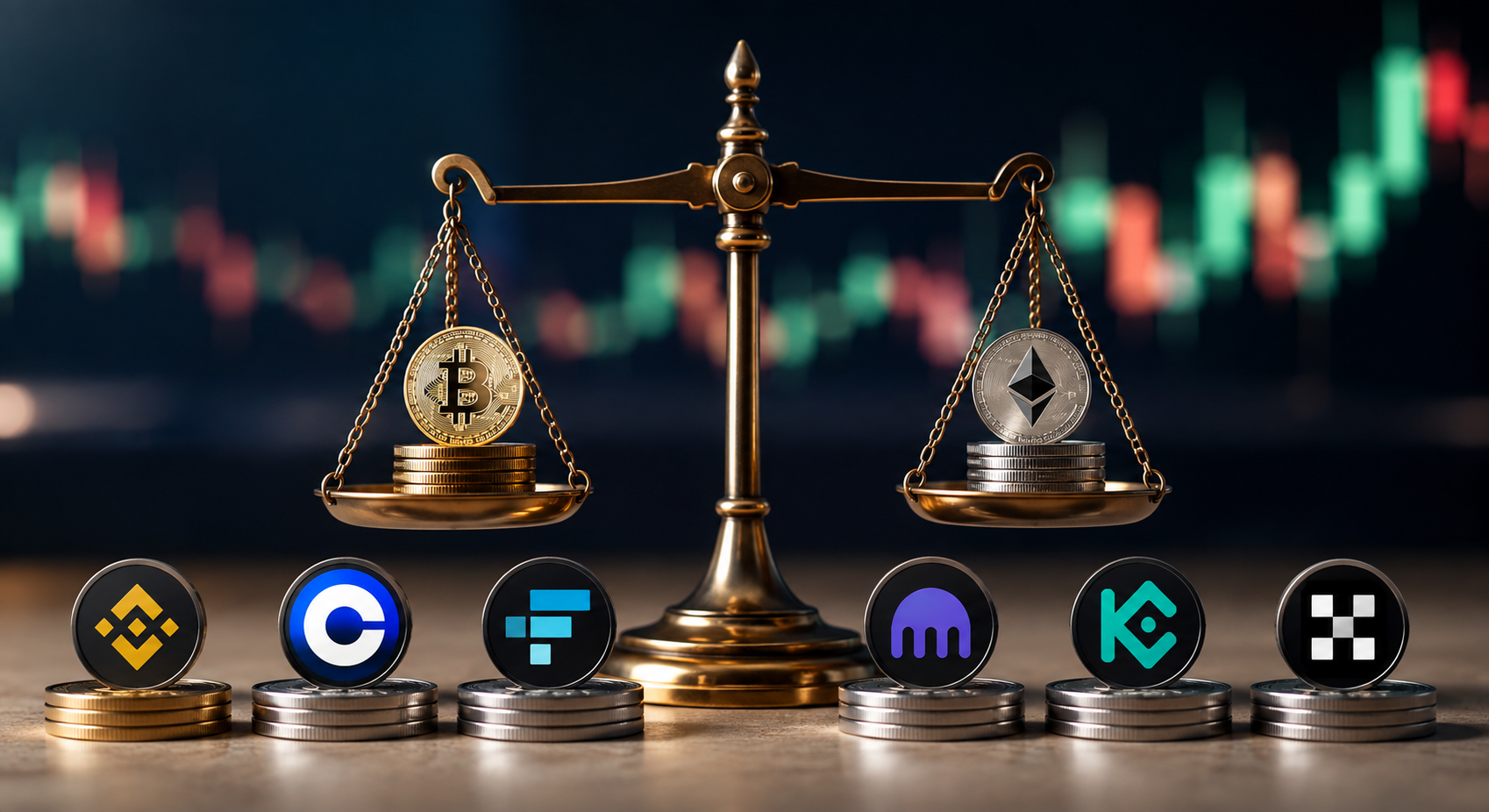
A crypto exchange fee comparison saves you real money over time. Small fee gaps look tiny on one trade. However, they add up fast once you trade often or move large amounts. So this crypto exchange fee comparison ranks 20 platforms by their published spot trading costs, so you can see where your money actually goes.
Fees fall into a few buckets. Also, trading fees, spreads, and withdrawal costs all shape your true total. So a fair crypto exchange fee comparison must look past the flashy headline number alone. Below, we rank platforms by base-tier spot cost, explain the maker-taker model, and flag where hidden costs tend to hide.
One quick note before the table. Exchanges update fee schedules often, sometimes every few months. So treat every figure here as a snapshot from mid-2026, and always confirm the live rate before you trade.
How This Crypto Exchange Fee Comparison Works
Most platforms use a maker-taker model. A maker places a limit order that waits on the book, adding liquidity. Meanwhile, a taker places a market order that fills right away, removing liquidity. Makers usually pay less, since they help build the order book.
Base-tier rates apply to smaller monthly volume, often under $10,000. Meanwhile, larger traders unlock lower rates as their volume climbs. Also, many exchanges cut fees further for users who hold and pay with the platform’s own token. So the “real” rate for an active trader often looks nothing like the sticker price.
Beyond trading fees, watch two more costs closely. First, spreads on simple buy interfaces can quietly add far more cost than the listed trading fee, which is exactly why a fair crypto exchange fee comparison checks both. Second, withdrawal fees vary a lot by coin and network, so moving funds off-platform can carry its own hidden charge.
The 20 Platforms Ranked by Total Cost
The list below runs from the lowest published base-tier spot cost toward the highest. Figures reflect standard retail rates without token discounts, unless noted.
- MEXC — 0% maker, 0.05% taker. Among the lowest published base rates of any major platform.
- Binance.US — 0% maker, 0.02% taker. A strong pick for cost-focused US traders.
- Binance — 0.10% maker, 0.10% taker, dropping to 0.075% when fees are paid in BNB.
- Bybit — around 0.10% maker and taker on spot, with promotional rates on select pairs.
- Bitget — 0.10% maker, 0.10% taker, reduced to 0.08% when paid in BGB.
- KuCoin — 0.10% maker and taker on base-tier pairs, falling toward 0% maker and 0.025% taker at top volume tiers.
- OKX — historically a low base rate, though published figures vary by region and account type. Verify the current schedule before relying on it.
- Gate.io — commonly cited near the industry base range. Confirm the live rate before publishing exact figures.
- HTX — commonly cited near the industry base range. Confirm the live rate before publishing exact figures.
- Crypto.com — base spot fees start moderate but can drop toward zero for makers who stake a meaningful amount of CRO.
- Bitfinex — sits in the moderate range among established platforms. Confirm current published rates.
- Poloniex — sits in the moderate range among established platforms. Confirm current published rates.
- Kraken Pro — 0.25% maker, 0.40% taker at the base tier, with maker rebates available on hundreds of pairs.
- BitMart — sits in the moderate-to-higher range among mid-size platforms. Confirm current published rates.
- CoinEx — sits in the moderate-to-higher range among mid-size platforms. Confirm current published rates.
- Bitstamp — sits toward the higher end of the base-tier range among established platforms. Confirm current published rates.
- Gemini (standard interface) — a wide, spread-based cost that runs well above the exchange’s own ActiveTrader tier.
- Coinbase Advanced Trade — 0.40% maker, 0.60% taker at the base tier, still cheaper than Coinbase’s simple buy flow.
- Kraken (instant buy) — a flat 1% convenience fee, separate from the far cheaper Kraken Pro order book.
- Coinbase (simple buy) — a spread of roughly 0.50%, which can widen toward 2% during volatile markets.
Where Beginners Overpay Without Realizing It
New traders often pick whichever app feels friendliest, then stick with the simple buy button forever. Also, that habit quietly costs more than any other mistake in this crypto exchange fee comparison. So the single biggest win for a beginner is learning to use the advanced or pro order screen instead.
For instance, switching from Coinbase’s simple buy to Coinbase Advanced Trade alone can cut costs dramatically on the exact same trade. Meanwhile, the same logic applies to Kraken’s instant buy versus Kraken Pro. Therefore, the platform choice often matters less than which screen you open once you get there.
Also, small trades feel forgiving, so the cost gap can go unnoticed for months. Once monthly volume grows, though, that same habit starts costing real money fast. A useful crypto exchange fee comparison should push every reader toward the advanced interface early, before the habit sets in.
How Volume Discounts Change the Ranking
The ranking above reflects base-tier rates for smaller traders. However, the picture shifts once monthly volume climbs past common thresholds. Also, many platforms cut both maker and taker rates sharply at higher tiers, sometimes by more than half.
For example, Kraken Pro’s published maker rebate program covers hundreds of trading pairs, rewarding consistent liquidity providers. Similarly, Binance’s VIP tiers push rates down toward a fraction of the base rate for the most active traders. So an exchange that looks mid-pack at low volume can jump toward the top once a trader qualifies for better pricing.
This is exactly why any serious crypto exchange fee comparison should ask about your expected volume before recommending a single winner. A casual trader and a high-frequency trader may reach very different answers from the same crypto exchange fee comparison.
A Quick Word on Regional Availability
Not every platform on this list serves every country. Also, regulatory rules shape which exchanges can legally operate in a given region, and that access can change with little warning. So the cheapest platform on paper means nothing if it does not accept traders from your country.
Additionally, some platforms offer different fee schedules by region due to local licensing requirements. Also, a rate quoted for one country’s users may not match what someone in another country actually pays. Therefore, always confirm both availability and local pricing together, rather than checking either one alone.
Why the Same Exchange Can Show Two Different Costs
Several exchanges on this list, including Coinbase and Kraken, show up twice in spirit. That is because their simple, one-click buy flow charges far more than their advanced order book. So always check which screen you are actually using before you judge an exchange’s true cost.
For instance, Coinbase’s simple interface embeds a spread that most users never see broken out. Meanwhile, Coinbase Advanced Trade shows a clear, separate fee line instead. Therefore, any honest crypto exchange fee comparison must treat these as two different products, not one single number.
Also, the same logic applies to token discounts. Binance, Bitget, and KuCoin all cut published rates further for users who pay fees with the platform’s own coin. So your real cost depends on choices you make, not just which platform you pick.
Why Rank Ordering Alone Can Mislead
A low headline rate does not always mean the lowest total cost. Thin order books can widen the effective spread on a market order, even at a platform with a tiny listed taker fee. So volume and liquidity matter just as much as the sticker price.
Also, withdrawal costs deserve real attention. Furthermore, sending the same stablecoin over different blockchain networks can cost ten times more on one network than another. Therefore, a platform with slightly higher trading fees but cheaper, flexible withdrawals might still win on total cost for some users.
Also, security and regulatory standing matter too. A platform with strong compliance history may justify a higher fee for traders who prioritize safety over shaving fractions of a percent off every trade.
How to Use This Crypto Exchange Fee Comparison
First, estimate your typical monthly trading volume. Base-tier rates apply below common thresholds, often $10,000, while heavier traders unlock steadily lower pricing on most platforms.
Next, decide whether you will use limit orders or market orders most often. Also, maker-focused traders benefit more from platforms with strong maker rebates, while frequent market-order traders should weigh taker rates most heavily.
Then, factor in withdrawal habits. Frequent movers between wallets and exchanges should check network fees for their most-used coins before committing to one platform.
Finally, revisit this crypto exchange fee comparison every few months. Also, rates shift often, and a platform that looked cheapest in one quarter can fall behind after a policy or pricing change.
Common Mistakes When Comparing Exchange Costs
One common mistake is comparing a simple buy screen against another platform’s advanced trading fee. These are not the same product, and the gap between them can be enormous. So always match interface type before judging any two platforms head to head.
Another mistake is ignoring token discounts entirely. A trader who already holds BNB, KCS, or BGB may pay meaningfully less than the base rate suggests. Therefore, factor in any token you already hold before ruling a platform out on price alone.
Additionally, some readers assume a fee schedule is permanent. Also, exchanges adjust pricing often, sometimes with little notice, so this crypto exchange fee comparison needs periodic updates. So treat any published table, including this one, as a starting point rather than a locked-in fact.
Limits to Keep in Mind
No table like this replaces checking a live fee schedule before a large trade. Published rates can lag behind promotional changes or new VIP tiers introduced mid-quarter. So the newest number on an exchange’s own site always wins over any outside summary.
Moreover, this comparison covers spot trading only. Also, futures, margin, staking, and card fees follow separate schedules that can differ sharply from spot pricing. Treat any crypto exchange fee comparison as a starting point for your own research, not a final word. Pair it with the exchange’s current fee page before moving meaningful money.
Final Thoughts
A crypto exchange fee comparison only helps if you look past the headline number. By checking which interface you actually use, factoring in token discounts, and watching withdrawal costs, you get a far more honest read on total cost. As platforms keep adjusting pricing through 2026, revisiting this kind of comparison regularly will keep more of your money working for you instead of covering fees.
So start with your own trading habits. Match them against the platforms above, and confirm current rates directly on each exchange before you commit real funds. Over time, this habit alone, guided by a solid crypto exchange fee comparison, can save far more than chasing the lowest headline number ever could.
FAQ
- What is the difference between a maker fee and a taker fee?
A maker fee applies to limit orders that sit on the book, while a taker fee applies to orders that fill immediately against existing orders. - Do exchange token discounts really make a big difference?
Yes. Paying fees in a platform’s native token, such as BNB or BGB, commonly cuts the published rate by a meaningful percentage. - Why does Coinbase show such different costs in different places?
Its simple buy flow uses a spread-based price, while Coinbase Advanced Trade shows a separate, usually much lower, commission instead. - Are withdrawal fees included in most published trading fee tables?
Rarely. Most tables focus only on trading costs, so withdrawal fees need a separate check based on the coin and network you plan to use. - How often should traders recheck exchange fee schedules?
A quarterly check works well for most traders, though anyone moving large sums should confirm rates right before every major trade.