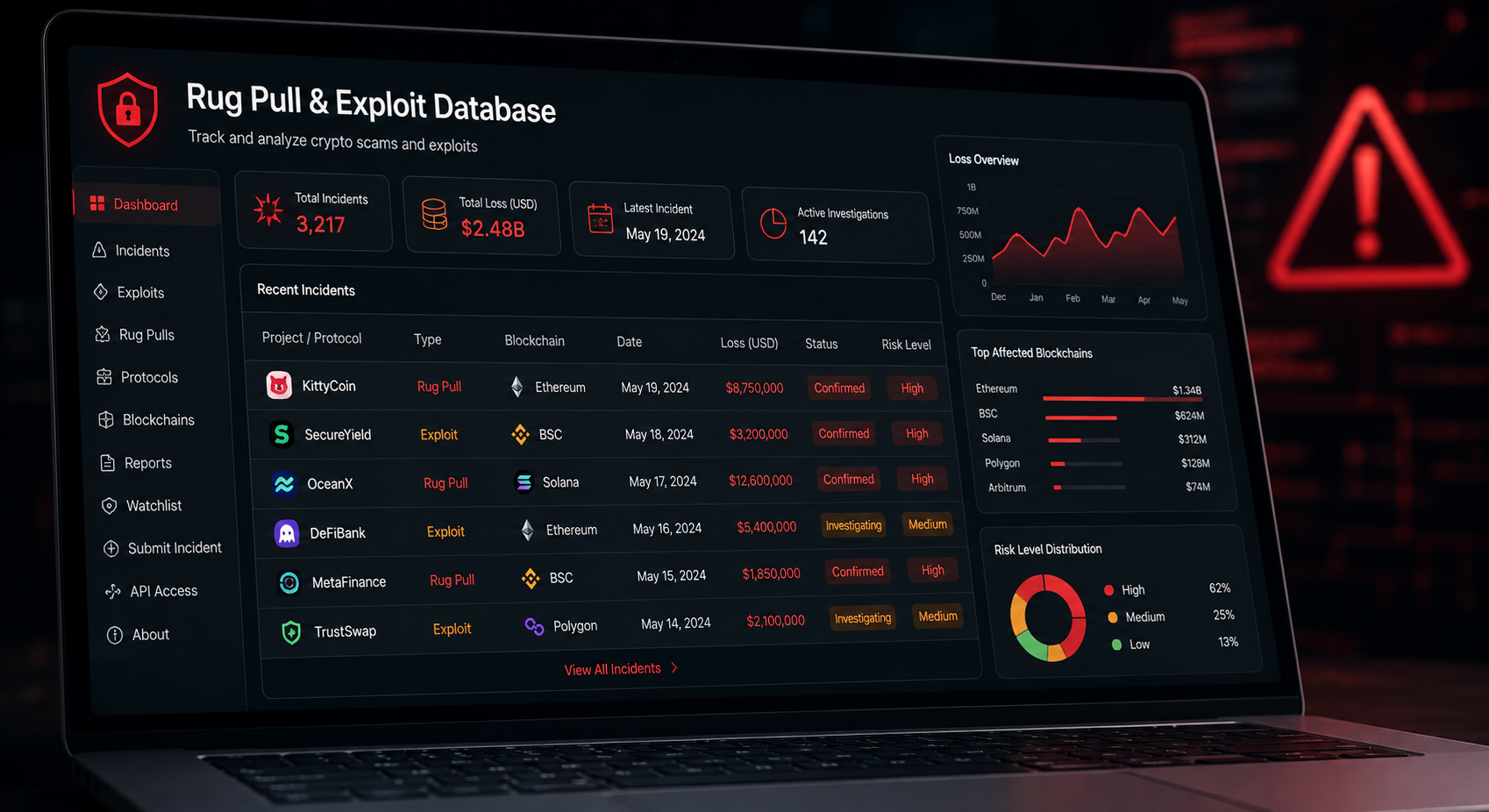
A rug pull and exploit database gives you one place to check real crypto losses. Instead of trusting rumors on social media, you can look at cases tracked by security firms. This guide explains how these records get built. It also walks through verified 2026 hacks and shows how to read the numbers with care.
Crypto security firms tracked well over 200 confirmed hacks during the first half of 2026 alone. Total losses across trackers ranged from roughly $970 million to $1.3 billion. Also, the gap depends on which firm did the counting. So a careful rug pull and exploit database matters more than ever for anyone holding digital assets. Whether you are a builder, an investor, or just curious, this guide breaks down what the verified data actually shows.
Overall, two very different threats sit under one umbrella here. Hacks involve outside attackers breaking in. Rug pulls involve a project’s own team walking away with funds. Below, we cover both. We also cover how a solid tracking habit helps you stay safer.
What Goes Into a Rug Pull and Exploit Database
At its core, a rug pull and exploit database records confirmed events, not rumors. Firms like Blockaid, TRM Labs, and CertiK track on-chain activity. Then, they confirm losses, and publish figures once details settle. This matters, since early social posts often guess wrong on the amount lost.
For instance, several trackers reported different totals for the same six-month stretch in 2026. Figures ranged from about $970 million up past $1.3 billion. Meanwhile, case counts also varied, from roughly 207 up to 344. Each firm defines a countable event a bit differently. However, most trackers agreed on one key point. Therefore, checking more than one source before citing a figure protects you from repeating a shaky number.
A strong database also separates causes clearly. Smart contract bugs, stolen private keys, and social engineering all lead to different lessons for builders and users alike.
Also, good trackers note recovery status. Some stolen funds get frozen or returned. So a raw loss figure can shrink meaningfully once recovery work finishes.
Hacks vs. Rug Pulls: Two Very Different Threats
A hack means someone broke something that was not supposed to break. An attacker might exploit a bug, steal a private key, or trick an employee into approving a bad transaction. Also, the project itself is usually a victim too, not the source of the harm. This is why a careful rug pull and exploit database keeps hacks and rug pulls in separate columns.
For instance, the Drift Protocol incident in April 2026 lost roughly $285 million. Attackers compromised admin keys, not a coding flaw. Meanwhile, the KelpDAO exploit that same month lost about $292 million. Compromised internal systems fed false data to a cross-chain bridge. However, in both cases, the project’s own team did not walk away with funds. Therefore, calling these events “rug pulls” would misdescribe what actually happened.
A rug pull, on the other hand, means the team itself planned the exit. Developers may quietly drain a liquidity pool, disable withdrawals, or simply vanish with investor funds. This pattern is exactly what a rug pull and exploit database exists to catch early. Thus, a fair rug pull and exploit database always separates outside attacks from inside betrayals. The fix for each threat looks completely different.
In short, both threats drain wallets. Only one, though, involves genuine victims on the team’s side too.
Verified 2026 Hacks Worth Knowing
Throughout 2026, a handful of cases stood out for their size and clear cause. The KelpDAO exploit on April 18 drained roughly $292 million. Compromised internal RPC nodes fed a cross-chain bridge false data. Blockchain research firms linked the attack to North Korea-linked actors.
Just weeks earlier, on April 1, Drift Protocol lost around $285 million on Solana. Compromised admin keys caused the loss, not a smart contract flaw. Nevertheless, together these two events made up nearly half of all first-half 2026 losses across the entire industry. So a small number of large, well-planned attacks drove most of the year’s damage.
Some smaller cases still carry useful lessons. CowSwap lost roughly $50.4 million from a single bad signature approval. This is a reminder that approval habits matter even on established platforms. Meanwhile, an incident tied to Resolv Labs involved an $80 million unbacked stablecoin mint. It showed that even backing rules can fail under the wrong conditions.
Meanwhile, oracle problems kept surfacing in smaller doses. Aave V3, Venus Protocol, and Resolv Labs all reported losses tied to shaky price feeds during March 2026. Each loss ranged from roughly one million to a few million dollars.
How Rug Pulls Typically Unfold
Rug pulls tend to follow a familiar shape, even though exact tactics vary. A team launches a token, builds hype fast, and encourages early buying before the project has much real substance behind it. Then, once enough money flows in, the team pulls liquidity or disables selling entirely.
Warning signs often show up before the exit. Also, anonymous teams, locked or unclear contract code, and outsized early marketing spend all raise real questions. Additionally, a token that lets buying but blocks or heavily taxes selling deserves close scrutiny before anyone commits funds.
A well-built rug pull and exploit database flags these patterns, not just completed exits. This forward-looking view helps cautious investors spot risk before losing money, not just read about it afterward. That is the real value a rug pull and exploit database offers over a simple news search.
Who Actually Relies on This Kind of Database
Builders and auditors use a rug pull and exploit database to study real failure patterns before they design new systems. Seeing how KelpDAO’s bridge got fooled, for instance, teaches lessons that no textbook covers quite as clearly.
Also, everyday investors benefit from a lighter version of this habit. Checking whether a project or team shows up in past incident reports takes only a few minutes and can prevent a costly mistake.
Journalists and researchers lean on this data too. A clear rug pull and exploit database lets them separate confirmed losses from social media rumors before publishing a headline number.
Why Confirming a Hack Takes Time
Confirming who caused a hack often takes weeks or months. First, investigators trace wallet movements and cross-reference known attacker patterns. Sometimes they wait for law enforcement confirmation before naming a source. So early headlines about “who did it” deserve real skepticism.
For example, the FBI formally named a known state-linked group behind the record-setting Bybit exchange hack within days of the breach. That speed is unusual. Meanwhile, many smaller cases never get an official source named at all. Tracing funds through mixers and cross-chain bridges takes serious resources.
Therefore, a responsible rug pull and exploit database labels an unconfirmed cause clearly. It should never repeat an early guess as settled fact.
How to Read Loss Figures Without Getting Fooled
First, check whether a figure represents gross loss or net loss after any recovery. Some high-profile hacks saw a meaningful share of stolen funds frozen or returned within days.
Next, compare figures across more than one tracker before treating a number as final. Also, different firms count differently. A gap between two trackers does not always mean one of them made an error.
Then, watch for clustering. In the first half of 2026, just two cases made up nearly half of all reported losses. So a handful of large events, not hundreds of small ones, usually drives the headline total for any given period. This clustering is exactly the kind of pattern a good rug pull and exploit database should highlight.
Common Mistakes When Using This Kind of Data
One common mistake is treating every dollar figure as final on day one. Also, early reports often estimate losses before full review finishes. Figures can shift once investigators complete their work.
Another mistake is lumping hacks and rug pulls into one bucket. Also, doing so blurs an important line between outside criminals and inside bad actors. That distinction matters for anyone deciding who to trust with future investments.
Additionally, some readers assume a high case count always means high dollar losses. In 2026, the case count hit a record high even as total dollar losses came in lower than 2025’s peak. So volume and severity tell two separate stories.
Limits to Keep in Mind
No public rug pull and exploit database captures every incident. Also, smaller thefts sometimes go unreported, especially when victims fear bad press or simply do not realize what happened. So published totals likely understate the true scale somewhat.
Moreover, these records describe the past, not future risk for any specific project. A protocol with no past cases is not automatically safe going forward. Treat any historical tracker as a starting point for research, not a guarantee. Also, pair it with your own review of a project’s code, team, and audit history before committing funds.
A Simple Habit for Staying Informed
Many careful investors check a trusted tracker on a set schedule rather than only after a scary headline. One simple habit might mean a monthly scan of major reported cases and their root causes.
During that check, note whether losses trace to a hack or a rug pull. Also note which attack type keeps repeating. Over time, this habit builds a real feel for where current risk sits, rather than reacting to whichever story trends that week.
You do not need specialized tools to start. Following a few reputable security firms and checking their published reports each month works well for most people.
Final Thoughts
A rug pull and exploit database turns scattered headlines into a clearer, more honest picture of crypto risk. Separating outside hacks from inside betrayals helps. So does checking more than one tracker and watching how figures shift as investigations finish. Together, these habits give you a far more accurate read on where real danger sits. As attackers keep adapting through 2026, this kind of tracking will only grow more valuable for anyone active in the space.
So start simple. Follow a couple of reputable trackers, check in monthly, and note the pattern behind each new incident. Over time, this habit builds real judgment that a single scary headline never could.
FAQ
- What is the main difference between a hack and a rug pull?
A hack involves an outside attacker breaking a system, while a rug pull involves a project’s own team intentionally taking investor funds. - Why do loss figures often change after an incident?
Early estimates rely on partial information, and figures often shift once investigators complete review or funds get frozen and recovered. - Which attack type caused the most damage in 2026?
Infrastructure and key compromises, rather than smart contract bugs, drove the majority of dollar losses during the first half of the year. - Can a project with no past incidents still be risky?
Yes. A clean track record does not guarantee future safety, since new weak spots and team behavior can change at any time. - How quickly can investigators confirm who caused a hack?
It varies widely. Some cases see a fast, confirmed source within days, while many smaller incidents never get one at all.